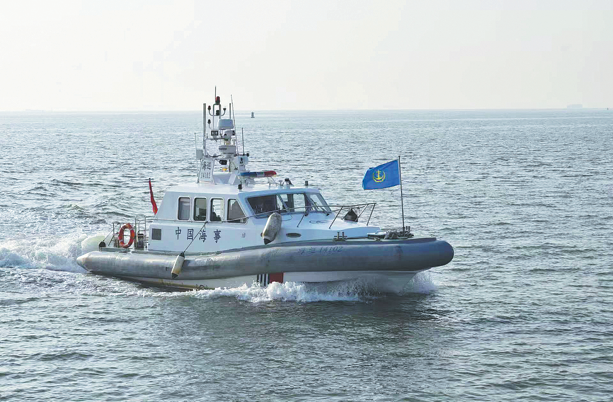
On a busy stretch of water in Shenzhen, Guangdong province, a 12-meter-long maritime patrol vessel adjusted its course, followed its assigned route and scanned the surface for potential hazards — all without an officer having to steer it through every maneuver.
The vessel, Haixun 14102, is China’s first maritime law enforcement boat to receive an integrated digital and intelligent upgrade. Equipped with an intelligent navigation module, multiple sensing devices and a platform linking the vessel with a shore-based control center, it entered trial operation in early July, according to the Maritime Safety Administration under the Ministry of Transport.
The pilot reflects China’s broader push to integrate artificial intelligence, connected navigation systems and remote monitoring into one of the world’s largest water transport networks.
China’s ports handled 18.34 billion metric tons of cargo and 354 million 20-foot equivalent units of containers in 2025, while its navigable inland waterways extended for 128,700 kilometers, according to the Ministry of Transport.
As the network has expanded, the focus of water transport development has broadened beyond ports, berths and shipping channels to improving coordination among vessels, navigation facilities, shore-based platforms and maritime authorities.
The Smart Shipping 2030 Action Plan, jointly issued by the Ministry of Transport and three other central government departments earlier this year, calls for deeper integration of AI with vessels, ports, waterways, navigation support services and maritime supervision.
By 2027, China plans to establish at least three comprehensive smart shipping pilot regions, open more than five pilot routes, develop over 10 replicable application scenarios and put more than 100 intelligent vessels into operation. Priority applications include emergency rescue, navigation at night or in fog, operations in narrow and winding waterways, waterborne construction and short-distance transport.