The midsummer heat is stifling, yet inside the exhibition halls of the 2026 World Artificial Intelligence Conference — which recently concluded in Shanghai — the temperature also feels high due to a flurry of activity.
The whir of featured technology in operation, the narration of product launches and the cacophony of conversations in multiple tongues weave together into a constant hum that reverberates through the vast space. Industry professionals, academic researchers and ordinary citizens weave from booth to booth, checking out futuristic tech and experiencing AI agents firsthand. The packed halls, buzzing with energy, paint a vivid portrait of a burgeoning AI sector charging forward at full throttle.
This year’s WAIC has broken its own records: the total exhibition area exceeded 100,000 square meters for the first time, with more than 1,100 companies showcasing over 3,000 exhibits and over 300 products making their global debut. More than 1,400 Chinese and foreign special guests gathered together, with the on-site excitement unmistakable.
Yet beyond the sheer scale, what truly stands out is the message emanating from displays across the AI industry chain: AI is moving from code on screens to factories, pharmacies and office desks. Robots and large models are not only finding specific applications, but have also entered a moment of “getting things done”, officials, corporate executives and experts said.
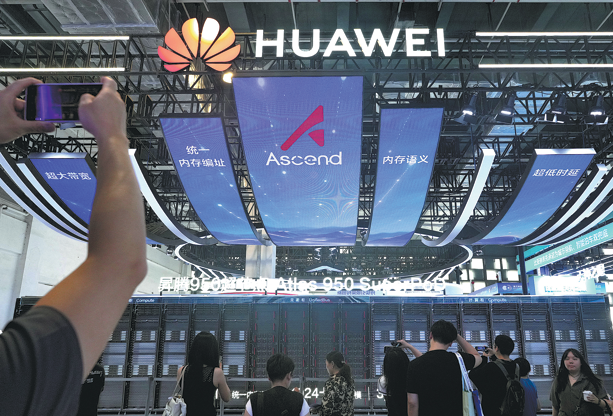
Moreover, the computing power exhibition area — which undergirds AI — also offered plenty of highlights, with multiple domestically produced computing products making a collective appearance, they added.
Outside the venue, AI has already crossed the boundaries of the laboratory, surging as a powerful wave across the globe. Many visitors still recall that the 2024 WAIC featured just 25 humanoid robots; this year, the embodied intelligence sector alone brought together over 200 companies. In just two years, the field has leapfrogged from “looking at appearance” to “looking at capability” and then to “looking at real-world deployment”.
The Ministry of Industry and Information Technology said China has taken the lead in achieving mass production of humanoid robots, with its global shipment share reaching as high as 90 percent in 2025, with humanoid robot production seen topping 100,000 units in China this year.
“This leap is no accident,” said Wei Liang, vice-president of the China Academy of Information and Communications Technology. “Behind the transition from small-batch trial production to large-scale mass production lies a combination of improved domestic large language model capabilities, falling costs for core components and the continuous accumulation of scenario-based data.”